Tuesday, February 14, 2012

Augmented Reality in a Contact Lens

Image: Raygun Studio

The human eye is a perceptual powerhouse. It can see millions of colors, adjust easily to shifting light conditions, and transmit information to the brain at a rate exceeding that of a high-speed Internet connection.

But why stop there?

In the Terminator movies, Arnold Schwarzenegger’s character sees the world with data superimposed on his visual field—virtual captions that enhance the cyborg’s scan of a scene. In stories by the science fiction author Vernor Vinge, characters rely on electronic contact lenses, rather than smartphones or brain implants, for seamless access to information that appears right before their eyes.

These visions (if I may) might seem far-fetched, but a contact lens with simple built-in electronics is already within reach; in fact, my students and I are already producing such devices in small numbers in my laboratory at the University of Washington. These lenses don’t give us the vision of an eagle or the benefit of running subtitles on our surroundings yet. But we have built a lens with one LED, which we’ve powered wirelessly with RF. What we’ve done so far barely hints at what will soon be possible with this technology.

Conventional contact lenses are polymers formed in specific shapes to correct faulty vision. To turn such a lens into a functional system, we integrate control circuits, communication circuits, and miniature antennas into the lens using custom-built optoelectronic components. Those components will eventually include hundreds of LEDs, which will form images in front of the eye, such as words, charts, and photographs. Much of the hardware is semitransparent so that wearers can navigate their surroundings without crashing into them or becoming disoriented. In all likelihood, a separate, portable device will relay displayable information to the lens’s control circuit, which will operate the optoelectronics in the lens.

These lenses don’t need to be very complex to be useful. Even a lens with a single pixel could aid people with impaired hearing or be incorporated as an indicator into computer games. With more colors and resolution, the repertoire could be expanded to include displaying text, translating speech into captions in real time, or offering visual cues from a navigation system. With basic image processing and Internet access, a contact-lens display could unlock whole new worlds of visual information, unfettered by the constraints of a physical display.

Besides visual enhancement, noninvasive monitoring of the wearer’s biomarkers and health indicators could be a huge future market. We’ve built several simple sensors that can detect the concentration of a molecule, such as glucose. Sensors built onto lenses would let diabetic wearers keep tabs on blood-sugar levels without needing to prick a finger. The glucose detectors we’re evaluating now are a mere glimmer of what will be possible in the next 5 to 10 years. Contact lenses are worn daily by more than a hundred million people, and they are one of the only disposable, mass-market products that remain in contact, through fluids, with the interior of the body for an extended period of time. When you get a blood test, your doctor is probably measuring many of the same biomarkers that are found in the live cells on the surface of your eye—and in concentrations that correlate closely with the levels in your bloodstream. An appropriately configured contact lens could monitor cholesterol, sodium, and potassium levels, to name a few potential targets. Coupled with a wireless data transmitter, the lens could relay information to medics or nurses instantly, without needles or laboratory chemistry, and with a much lower chance of mix-ups.


ar-contact1.jpg (639×595)

Three fundamental challenges stand in the way of building a multipurpose contact lens. First, the processes for making many of the lens’s parts and subsystems are incompatible with one another and with the fragile polymer of the lens. To get around this problem, my colleagues and I make all our devices from scratch. To fabricate the components for silicon circuits and LEDs, we use high temperatures and corrosive chemicals, which means we can’t manufacture them directly onto a lens. That leads to the second challenge, which is that all the key components of the lens need to be miniaturized and integrated onto about 1.5 square centimeters of a flexible, transparent polymer. We haven’t fully solved that problem yet, but we have so far developed our own specialized assembly process, which enables us to integrate several different kinds of components onto a lens. Last but not least, the whole contraption needs to be completely safe for the eye. Take an LED, for example. Most red LEDs are made of aluminum gallium arsenide, which is toxic. So before an LED can go into the eye, it must be enveloped in a biocompatible substance.

So far, besides our glucose monitor, we’ve been able to batch-fabricate a few other nanoscale biosensors that respond to a target molecule with an electrical signal; we’ve also made several microscale components, including single-crystal silicon transistors, radio chips, antennas, diffusion resistors, LEDs, and silicon photodetectors. We’ve constructed all the micrometer-scale metal interconnects necessary to form a circuit on a contact lens. We’ve also shown that these microcomponents can be integrated through a self-assembly process onto other unconventional substrates, such as thin, flexible transparent plastics or glass. We’ve fabricated prototype lenses with an LED, a small radio chip, and an antenna, and we’ve transmitted energy to the lens wirelessly, lighting the LED. To demonstrate that the lenses can be safe, we encapsulated them in a biocompatible polymer and successfully tested them in trials with live rabbits.

Photos: University of Washington

Second Sight:

In recent trials, rabbits wore lenses containing metal circuit structures for 20 minutes at a time with no adverse effects.

Seeing the light—LED light—is a reasonable accomplishment. But seeing something useful through the lens is clearly the ultimate goal. Fortunately, the human eye is an extremely sensitive photodetector. At high noon on a cloudless day, lots of light streams through your pupil, and the world appears bright indeed. But the eye doesn’t need all that optical power—it can perceive images with only a few microwatts of optical power passing through its lens. An LCD computer screen is similarly wasteful. It sends out a lot of photons, but only a small fraction of them enter your eye and hit the retina to form an image. But when the display is directly over your cornea, every photon generated by the display helps form the image.

The beauty of this approach is obvious: With the light coming from a lens on your pupil rather than from an external source, you need much less power to form an image. But how to get light from a lens? We’ve considered two basic approaches. One option is to build into the lens a display based on an array of LED pixels; we call this an active display. An alternative is to use passive pixels that merely modulate incoming light rather than producing their own. Basically, they construct an image by changing their color and transparency in reaction to a light source. (They’re similar to LCDs, in which tiny liquid-crystal ”shutters” block or transmit white light through a red, green, or blue filter.) For passive pixels on a functional contact lens, the light source would be the environment. The colors wouldn’t be as precise as with a white-backlit LCD, but the images could be quite sharp and finely resolved.

We’ve mainly pursued the active approach and have produced lenses that can accommodate an 8-by-8 array of LEDs. For now, active pixels are easier to attach to lenses. But using passive pixels would significantly reduce the contact’s overall power needs—if we can figure out how to make the pixels smaller, higher in contrast, and capable of reacting quickly to external signals.

By now you’re probably wondering how a person wearing one of our contact lenses would be able to focus on an image generated on the surface of the eye. After all, a normal and healthy eye cannot focus on objects that are fewer than 10 centimeters from the corneal surface. The LEDs by themselves merely produce a fuzzy splotch of color in the wearer’s field of vision. Somehow the image must be pushed away from the cornea. One way to do that is to employ an array of even smaller lenses placed on the surface of the contact lens. Arrays of such microlenses have been used in the past to focus lasers and, in photolithography, to draw patterns of light on a photoresist. On a contact lens, each pixel or small group of pixels would be assigned to a microlens placed between the eye and the pixels. Spacing a pixel and a microlens 360 micrometers apart would be enough to push back the virtual image and let the eye focus on it easily. To the wearer, the image would seem to hang in space about half a meter away, depending on the microlens.

Another way to make sharp images is to use a scanning microlaser or an array of microlasers. Laser beams diverge much less than LED light does, so they would produce a sharper image. A kind of actuated mirror would scan the beams from a red, a green, and a blue laser to generate an image. The resolution of the image would be limited primarily by the narrowness of the beams, and the lasers would obviously have to be extremely small, which would be a substantial challenge. However, using lasers would ensure that the image is in focus at all times and eliminate the need for microlenses.

Whether we use LEDs or lasers for our display, the area available for optoelectronics on the surface of the contact is really small: roughly 1.2 millimeters in diameter. The display must also be semitransparent, so that wearers can still see their surroundings. Those are tough but not impossible requirements. The LED chips we’ve built so far are 300 µm in diameter, and the light-emitting zone on each chip is a 60-µm-wide ring with a radius of 112 µm. We’re trying to reduce that by an order of magnitude. Our goal is an array of 3600 10-µm-wide pixels spaced 10 µm apart.

One other difficulty in putting a display on the eye is keeping it from moving around relative to the pupil. Normal contact lenses that correct for astigmatism are weighted on the bottom to maintain a specific orientation, give or take a few degrees. I figure the same technique could keep a display from tilting (unless the wearer blinked too often!).

Like all mobile electronics, these lenses must be powered by suitable sources, but among the options, none are particularly attractive. The space constraints are acute. For example, batteries are hard to miniaturize to this extent, require recharging, and raise the specter of, say, lithium ions floating around in the eye after an accident. A better strategy is gathering inertial power from the environment, by converting ambient vibrations into energy or by receiving solar or RF power. Most inertial power scavenging designs have unacceptably low power output, so we have focused on powering our lenses with solar or RF energy.

Let’s assume that 1 square centimeter of lens area is dedicated to power generation, and let’s say we devote the space to solar cells. Almost 300 microwatts of incoming power would be available indoors, with potentially much more available outdoors. At a conversion efficiency of 10 percent, these figures would translate to 30 µW of available electrical power, if all the subsystems of the contact lens were run indoors.

Collecting RF energy from a source in the user’s pocket would improve the numbers slightly. In this setup, the lens area would hold antennas rather than photovoltaic cells. The antennas’ output would be limited by the field strengths permitted at various frequencies. In the microwave bands between 1.5 gigahertz and 100 GHz, the exposure level considered safe for humans is 1 milliwatt per square centimeter. For our prototypes, we have fabricated the first generation of antennas that can transmit in the 900-megahertz to 6-GHz range, and we’re working on higher-efficiency versions. So from that one square centimeter of lens real estate, we should be able to extract at least 100 µW, depending on the efficiency of the antenna and the conversion circuit.

Having made all these subsystems work, the final challenge is making them all fit on the same tiny polymer disc. Recall the pieces that we need to cram onto a lens: metal microstructures to form antennas; compound semiconductors to make optoelectronic devices; advanced complementary metal-oxide-semiconductor silicon circuits for low-power control and RF telecommunication; microelectromechanical system (MEMS) transducers and resonators to tune the frequencies of the RF communication; and surface sensors that are reactive with the biochemical environment.

The semiconductor fabrication processes we’d typically use to make most of these components won’t work because they are both thermally and chemically incompatible with the flexible polymer substrate of the contact lens. To get around this problem, we independently fabricate most of the microcomponents on silicon-on-insulator wafers, and we fabricate the LEDs and some of the biosensors on other substrates. Each part has metal interconnects and is etched into a unique shape. The end yield is a collection of powder-fine parts that we then embed in the lens.

We start by preparing the substrate that will hold the microcomponents, a 100-µm-thick slice of polyethylene terephthalate. The substrate has photolithographically defined metal interconnect lines and binding sites. These binding sites are tiny wells, about 10 µm deep, where electrical connections will be made between components and the template. At the bottom of each well is a minuscule pool of a low-melting-point alloy that will later join together two interconnects in what amounts to micrometer-scale soldering.

We then submerge the plastic lens substrate in a liquid medium and flow the collection of microcomponents over it. The binding sites are cut to match the geometries of the individual parts so that a triangular component finds a triangular well, a circular part falls into a circular well, and so on. When a piece falls into its complementary well, a small metal pad on the surface of the component comes in contact with the alloy at the bottom of the well, causing a capillary force that lodges the component in place. After all the parts have found their slots, we drop the temperature to solidify the alloy. This step locks in the mechanical and electrical contact between the components, the interconnects, and the substrate.

The next step is to ensure that all the potentially harmful components that we’ve just assembled are completely safe and comfortable to wear. The lenses we’ve been developing resemble existing gas-permeable contacts with small patches of a slightly less breathable material that wraps around the electronic components. We’ve been encapsulating the functional parts with poly(methyl methacrylate), the polymer used to make earlier generations of contact lenses. Then there’s the question of the interaction of heat and light with the eye. Not only must the system’s power consumption be very low for the sake of the energy budget, it must also avoid generating enough heat to damage the eye, so the temperature must remain below 45 °C. We have yet to investigate this concern fully, but our preliminary analyses suggest that heat shouldn’t be a big problem.

eye04
Photos: University of Washington

In Focus:

One lens prototype [left] has several interconnects, single-crystal silicon components, and compound-semiconductor components embedded within. Another sample lens [right] contains a radio chip, an antenna, and a red LED.

All the basic technologies needed to build functional contact lenses are in place. We’ve tested our first few prototypes on animals, proving that the platform can be safe. What we need to do now is show all the subsystems working together, shrink some of the components even more, and extend the RF power harvesting to higher efficiencies and to distances greater than the few centimeters we have now. We also need to build a companion device that would do all the necessary computing or image processing to truly prove that the system can form images on demand. We’re starting with a simple product, a contact lens with a single light source, and we aim to work up to more sophisticated lenses that can superimpose computer-generated high-resolution color graphics on a user’s real field of vision.

The true promise of this research is not just the actual system we end up making, whether it’s a display, a biosensor, or both. We already see a future in which the humble contact lens becomes a real platform, like the iPhone is today, with lots of developers contributing their ideas and inventions. As far as we’re concerned, the possibilities extend as far as the eye can see, and beyond.

The author would like to thank his past and present students and collaborators, especially Brian Otis, Desney Tan, and Tueng Shen, for their contributions to this research.

Shrinking Memory Bits a Million Times Through Antiferromagnetically Coupled Atoms

Punctuating 30 years of nanotechnology research, scientists from IBM Research have successfully demonstrated the ability to store information in as few as 12 magnetic atoms. This is significantly less than today's disk drives, which use about one million atoms to store a single bit of information.


Technology - IC Layout


While silicon transistor technology has become cheaper, denser and more efficient, fundamental physical limitations suggest this path of conventional scaling is unsustainable. Alternative approaches are needed to continue the rapid pace of computing innovation. By taking a novel approach and beginning at the smallest unit of data storage, the atom, scientists demonstrated magnetic storage that is at least 100 times denser than today’s hard disk drives and solid state memory chips. Future applications of nanostructures built one atom at a time, and that apply an unconventional form of magnetism called antiferromagnetism, could allow people and businesses to store 100 times more information in the same space.

“The chip industry will continue its pursuit of incremental scaling in semiconductor technology but, as components continue to shrink, the march continues to the inevitable end point: the atom. We’re taking the opposite approach and starting with the smallest unit -- single atoms -- to build computing devices one atom at a time.” said Andreas Heinrich, the lead investigator into atomic storage at IBM Research – Almaden, in California.

This scanning tunneling microscope image shows a group of 12 iron atoms, the smallest magnetic memory bit ever made. Credit: IBM

IBM Scientists Create World's Smallest Magnetic Memory Bit, Paving The Way For 100 times denser HDDs and SSDs

Scientists from IBM Research have successfully demonstrated the ability to store information in as few as 12 magnetic atoms, a breakthough that could lead multiply the capacity of today's storage media.

For comparison, today's disk drives use about one million atoms to store a single bit of information.

While silicon transistor technology has become cheaper, denser and more efficient, fundamental physical limitations suggest this path of conventional scaling is unsustainable. Alternative approaches are needed to continue the rapid pace of computing innovation.

By taking a novel approach and beginning at the smallest unit of data storage, the atom, scientists demonstrated magnetic storage that is at least 100 times denser than today's hard disk drives and solid state memory chips. Future applications of nanostructures built one atom at a time, and that apply an unconventional form of magnetism called antiferromagnetism, could allow people and businesses to store 100 times more information in the same space.

"The chip industry will continue its pursuit of incremental scaling in semiconductor technology but, as components continue to shrink, the march continues to the inevitable end point: the atom. Were taking the opposite approach and starting with the smallest unit -- single atoms -- to build computing devices one atom at a time." said Andreas Heinrich, the lead investigator into atomic storage at IBM Research ? Almaden, in California.

How it Works

The most basic piece of information that a computer understands is a bit. Much like a light that can be switched on or off, a bit can have only one of two values: "1" or "0". Until now, it was unknown how many atoms it would take to build a reliable magnetic memory bit.

With properties similar to those of magnets on a refrigerator, ferromagnets use a magnetic interaction between its constituent atoms that align all their spins - the origin of the atoms' magnetism - in a single direction. Ferromagnets have worked well for magnetic data storage but a major obstacle for miniaturizing this down to atomic dimensions is the interaction of neighboring bits with each other. The magnetization of one magnetic bit can strongly affect that of its neighbor as a result of its magnetic field. Harnessing magnetic bits at the atomic scale to hold information or perform useful computing operations requires precise control of the interactions between the bits.

The scientists at IBM Research used a scanning tunneling microscope (STM) to atomically engineer a grouping of twelve antiferromagnetically coupled atoms that stored a bit of data for hours at low temperatures. Taking advantage of their inherent alternating magnetic spin directions, they demonstrated the ability to pack adjacent magnetic bits much closer together than was previously possible. This greatly increased the magnetic storage density without disrupting the state of neighboring bits.

Eureka! Kitchen Gadget Inspires Scientist to Make More Effective Plastic Electronics

One day in 2010, Rutgers physicist Vitaly Podzorov watched a store employee showcase a kitchen gadget that vacuum-seals food in plastic. The demo stuck with him. The simple concept – an airtight seal around pieces of food – just might apply to his research: developing flexible electronics using lightweight organic semiconductors for products such as video displays or solar cells.

Food - vacuum food sealer


“Organic transistors, which switch or amplify electronic signals, hold promise for making video displays that bend like book pages or roll and unroll like posters,” said Podzorov. But traditional methods of fabricating a part of the transistor known as the gate insulator often end up damaging the transistor’s delicate semiconductor crystals.

Drawing inspiration from the food-storage gadget, Podzorov and his colleagues tried an experiment. They suspended a thin polymer membrane above the organic crystal and created a vacuum underneath, causing the membrane to collapse gently and evenly onto the crystal’s surface. The result: a smooth, defect-free interface between the organic semiconductor and the gate insulator.

The researchers reported their success in the journal Advanced Materials. In the article, Podzorov and three colleagues describe how a single-crystal organic field effect transistor (OFET) made with this thin polymer gate insulator boosted electrical performance. The researchers further reported that they could remove and reapply membranes to the same crystal several times without degrading its surface.

Organic transistors electrically resemble silicon transistors in computer chips, but they are made of flexible carbon-based molecules that can be printed on sheets of plastic. Silicon transistors are made in rigid, brittle wafers of silicon.

The methods that scientists previously applied to organic transistor fabrication were based on silicon semiconductor processing, explained Podzorov, assistant professor in the Department of Physics and Astronomy, School of Arts and Sciences. These involved high temperatures, high-energy plasmas or chemical reactions, all of which could damage the delicate organic crystal surface and hinder the transistor’s performance.

“People have tendencies to go with something they’ve known for a long time,” he said. “In this case, it doesn’t work right.”

Podzorov’s innovation builds upon a decade of Rutgers research in this field, including his invention of the first single crystal organic transistor in 2003. While his latest innovation is still a ways from commercial reality, he sees an immediate application in the classroom.

“Our technique takes 10 minutes,” he said. “It should be exciting for students to actually build these devices and immediately see them work, all within one lab session.”

“We could place our samples between plastic sheets and pull a vacuum,” he said. “Then I thought, ‘why don’t we try doing this for our gate insulator?’


Why is the universe magnetized?


Why is the universe magnetized?

It's a question scientists have been asking for decades. Now, an international team of researchers including a University of Michigan professor have demonstrated that it could have happened spontaneously, as the prevailing theory suggests. The findings are published in Nature. Oxford University scientists led the research.

"According to our previous understanding, any magnetic field that had been made ought to have gone away by now," said Paul Drake, the Henry S. Carhart Collegiate Professor of Atmospheric, Oceanic, and Space Sciences and a professor in physics at the University of Michigan. "We didn't understand what mechanism might create a magnetic field, and even if it happened, we didn't understand why the magnetic field is still there. It has been a very enduring mystery".

Science - galactic magnetic.


With high-energy pulsed lasers in a French laboratory, the researchers created certain conditions analogous to those in the early universe when galaxies were forming. Through their experiment, they demonstrated that the theory known as the Biermann battery process is likely correct. Discovered by a German astronomer in 1950, the Biermann process predicts that a magnetic field can spring up spontaneously from nothing more than the motion of charged particles. Plasma, or charged particle gas, is abundant in space. Scientists believe that large clouds of gas collapsing into galaxies sent elliptically shaped bubbles of shockwaves through the early universe, touching off flows of electric current in the plasma of the intergalactic medium.

Anyone who has built an electromagnet in middle school science class is familiar with this concept, Drake said. "If you can make current flow, you make a magnetic field," Drake said. The question in astrophysics was what could have generated the current. This experiment demonstrated that such asymmetrical shockwaves could do the job. The results, Drake said, aren't particularly surprising. But it's important for scientists to test their theories with experiments. "These results help strengthen the understanding that we've taken from our interpretation of astrophysical data," Drake said. "And understanding the universe and most definitely the origin of life is one of the great human intellectual quests."

093001gssfig.gif (450×389)

A composite image (left) shows a laser-produced shock wave on the left side. Brighter colors show the shock region of higher density or temperature. The right side shows a simulation of a shock wave collapsing, as it would have during the pre-galactic phase in the universe.

The paper is titled "Generation of scaled protogalactic seed magnetic fields in laser produced shock waves." Other co-authors are from the University of Oxford, Rutherford Appleton Laboratory, Laboratoire pour l'Utilisation de Lasers Intenses, the University of Strathclyde, the University of California-Los Angeles, the University of York, the Institute of Laser Engineering at Osaka University, Lawrence Livermore National Laboratory and Wolfgang-Pauli-Strasse. The work is funded by the European Research Council, Laserlab-Europe, the Science and Technology Facilities Council, and the Engineering and Physical Sciences Research Council of the United Kingdom.

Half your Heating Bill With One 12 Inch " Miracle Tube "

Amazing British invention creates MORE energy than you put into it - and could soon be warming your home

It sounds too good to be true - not to mention the fact that it violates almost every known law of physics.

But British scientists claim they have invented a revolutionary device that seems to 'create' energy from virtually nothing.

Their so-called thermal energy cell could soon be fitted into ordinary homes, halving domestic heating bills and making a major contribution towards cutting carbon emissions.

Even the makers of the device are at a loss to explain exactly how it works - but sceptical independent scientists carried out their own tests and discovered that the 12in x 2in tube really does produce far more heat energy than the electrical energy put in.

The device seems to break the fundamental physical law that energy cannot be created from nothing - but researchers believe it taps into a previously unrecognised source of energy, stored at a sub-atomic level within the hydrogen atoms in water.


The system - developed by scientists at a firm called Ecowatts in a nondescript laboratory on an industrial estate at Lancing, West Sussex - involves passing an electrical current through a mixture of water, potassium carbonate (otherwise known as potash) and a secret liquid catalyst, based on chrome.

This creates a reaction that releases an incredible amount of energy compared to that put in. If the reaction takes place in a unit surrounded by water, the liquid heats up, which could form the basis for a household heating system.

If the technology can be developed on a domestic scale, it means consumers will need much less energy for heating and hot water - creating smaller bills and fewer greenhouse gases.


Nano Memory 1,000 Times Faster!!!!

Scientists from the University of Pennsylvania have developed nanowires capable of storing computer data for 100,000 years and retrieving that data a thousand times faster than existing portable memory devices such as Flash memory and micro-drives, all using less power and space than current memory technologies.

example of nanowires

...

Tests showed extremely low power consumption for data encoding (0.7mW per bit). They also indicated the data writing, erasing and retrieval (50 nanoseconds) to be 1,000 times faster than conventional Flash memory and indicated the device would not lose data even after approximately 100,000 years of use, all with the potential to realize terabit-level nonvolatile memory device density.

“This new form of memory has the potential to revolutionize the way we share information, transfer data and even download entertainment as consumers,” Agarwal said. “This represents a potential sea-change in the way we access and store data.”

...

Current solid-state technology for products like memory cards, digital cameras and personal data assistants traditionally utilize Flash memory, a non-volatile and durable computer memory that can be erased and reprogrammed electronically. Data on Flash drives provides most battery-powered devices with acceptable levels of durability and moderately fast data access. Yet the technology’s limits are apparent. Digital cameras can’t snap rapid-fire photos because it takes precious seconds to store the last photo to memory. If the memory device is fast, as in DRAM and SRAM used in computers, then it is volatile; if the plug on a desktop computer is pulled, all recent data entry is lost.

Therefore, a universal memory device is desired that can be scalable, fast, durable and nonvolatile, a difficult set of requirements which have now been demonstrated at Penn.

“Imagine being able to store hundreds of high-resolution movies in a small drive, downloading them and playing them without wasting time on data buffering, or imagine booting your laptop computer in a few seconds as you wouldn’t need to transfer the operating system to active memory” Agarwal said.

This may not be as impressive as the Optical Memory 50.000 Times Faster, but if this nano-memory gets here before optical memory... I'll just make due with the nano-memory for a while.

Cancer Cure May Be "Available In Two Years"


Cancer sufferers could be cured with injections of immune cells from other people within two years, scientists say.

US researchers have been given the go-ahead to give patients transfusions of “super strength” cancer-killing cells from donors.

Dr Zheng Cui, of the Wake Forest University School of Medicine, has shown in laboratory experiments that immune cells from some people can be almost 50 times more effective in fighting cancer than in others.

Dr Cui, whose work is highlighted in this week’s New Scientist magazine, has previously shown cells from mice found to be immune to cancer can be used to cure ordinary mice with tumours.

The work raises the prospect of using cancer-killing immune system cells called granulocytes from donors to significantly boost a cancer patient’s ability to fight their disease, and potentially cure them.

The US Food and Drug Administration (FDA) last week gave Dr Cui permission to inject super-strength granulocytes into 22 patients.

Dr Cui said: “Our hope is that this could be a cure. Our pre-clinical tests have been exceptionally successful.

“If this is half as effective in humans as it is in mice it could be that half of patients could be cured or at least given one to two years extra of high quality life.

“The technology needed to do this already exists, so if it works in humans we could save a lot of lives, and we could be doing so within two years.”

Dr Cui is confident patients could benefit from the technique quickly because the technology used to extract granulocytes is the same as that already used by hospitals to obtain other blood components such as plasma or platelets.

Prof Gribben, a cancer immunologist at Cancer Research UK’s experimental centre at St Bartholomew’s Hospital, London, said: “The concept of using immune system cells to kill off someone else’s cancer is very, very exciting.”

Dr Cui, who presented his latest findings at an anti-ageing conference in Cambridge last week, extracted granulocytes from 100 people, including some with cancer.

When the immune cells were mixed with cervical cancer cells, those from different individuals demonstrated vastly varying abilities to fight the cancer.

Those of the strongest participants killed close to 97 per cent of the cancer cells in 24 hours, while those of the weakest killed only two per cent.

The abilities of the cells of participants aged over 50 were lower than average, and those of cancer patients even lower.

Dr Cui noticed that the strength of a person’s immune system to combat cancer can also vary according to how stressed they are and the time of year.

Initial experiments suggest it may be possible to transfer granulocytes which have demonstrated strong cancer-fighting powers into cancer sufferers.

In 1999 Prof Cui and colleagues discovered a male mouse that appeared to be completely resistant to virulent cancer cells of several different types.

Since then more than 2000 mice in 15 generations have been bred from the original cancer-free mouse and 40 per cent of the offspring have inherited the immunity.

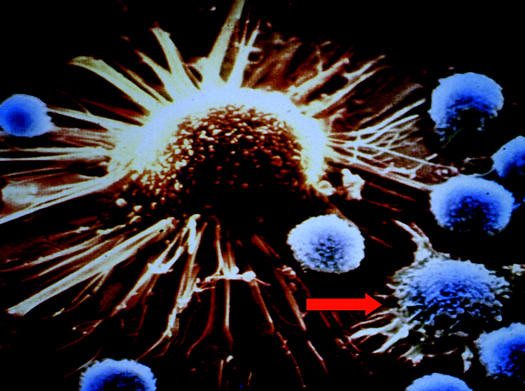
Probable cure: When tested on mice the tumours almost completely disappeared although it will be years before scientist will be able to run tests on humans

Probable cure: When tested on mice the tumours almost completely disappeared although it will be years before scientist will be able to run tests on humans (File photo)


With the immune system, some types of cells which provide “innate immunity” are constantly on patrol for foreign invaders, while others have to firstly learn to identify a specific threat before going on the attack.

Scientists developing cancer vaccines have generally attempted to stimulate responses in the immune system cells that require prior exposure.

Last year Dr Cui caused shockwaves in the cancer research community when he identified granulocytes as the cells responsible for the mouse cancer immunity – because they are among those which act automatically.

Prof Gribben said: “This is surprising because it goes against how we thought immune system works against cancer. It makes us think again about our preconceived notions.”

Prof Cui injected granulocytes from immune mice into ordinary mice, and found it was possible to give them protection from cancer.

Even more excitingly he found the transfusions caused existing cancers to go into remission and to clear them completely within weeks.

A single dose of the cells appeared to give many of the mice resistance to cancer for the rest of their lives.

Granulocyte transfusion has previously been used to try to prevent infections in cancer patients whose immune systems have been weakened by chemotherapy.

However their effectiveness has been unclear because they have mainly been given to patients in an advanced stage of disease.

Prof Gribben warned the US researchers would have to be careful to avoid other immune system cells from the donor proliferating in the patient’s body.

He added: “If they’re using live cells there is a theoretical risk of graft-versus-host disease, which can prove fatal.”

Dr Cui said he is working on ways to minimise this risk.

Scientists Create First Atomic X-Ray Laser And Heat Matter To 2-Million-Degrees

Scientists are currently using the most powerful X-ray laser in the world to further their understanding of fusion processes.


The U.S. Department of Energy is the proud owner of the Linac Coherent Light Source, the globe's most powerful X-ray laser. Researchers at the lab have worked over the past few years to craft the world's first atomic X-ray laser pulse, and to superheat and manipulate a cluster of matter heated to approximately 2 million degrees Celsius.

Scientists are hoping the X-ray laser pulse can help them understand how biological molecules function. What's more, they contend they are gaining insight into the processes of nuclear fusion through their work with superheated molecules. Engineers are conducting the experiments at DOE's SLAC National Accelerator Laboratory.

Popular Science reports that the researchers first use the Linac Coherent Light Source (LCLS) to flash-heat a miniature piece of aluminum foil, which ultimately results in the creation of what is known as hot dense matter. The laser is so powerful that it only takes approximately one-trillionth of a second to heat the aluminum to 2 million degrees Celsius, or 3.6 million degrees Fahrenheit.

Scientists assert that by developing a more comprehensive understanding of the process, they could one day understand and potentially recreate the process of nuclear fusion. Researchers have struggled to effectively incite nuclear fusion in laboratory settings, but SLAC's X-ray is enhancing their knowledge of how hot dense matter not only forms, but also acts.

"The LCLS X-ray laser is a truly remarkable machine," Oxford University postdoctoral fellow and study lead Sam Vinko said in a statement. "Making extremely hot, dense matter is important scientifically if we are ultimately to understand the conditions that exist inside stars and at the center of giant planets within our own solar system and beyond."

Vinko, who along with his fellow researchers published the study's findings in the journal Nature this week, acknowledged that scientists have long been able to create plasma from gases. However, the sheer power of the LCLS has enabled them to do the same at solid densities, a feat conventional lasers are incapable of achieving, according to study co-author Bob Nagler.

"The LCLS, with its ultra-short wavelengths of X-ray laser light, is the first that can penetrate a dense solid and create a uniform patch of plasma – in this case a cube one-thousandth of a centimeter on a side – and probe it at the same time," Nagler said.
This photograph shows the interior of a Linac Coherent Light Source SXR experimental chamber, set up for an investigation to create and measure a form of extreme, 2-million-degree matter known as “hot, dense matter.”

The central part of the frame contains the holder for the material that will be converted by the powerful LCLS laser into hot, dense matter. To the left is an XUV spectrometer and to the right is a small red laser set up for alignment and positioning.
Photo - Interior of a Linac Coherent Light Source experimental chamber at SLAC
Photo courtesy University of Oxford/Sam Vinko
"X-rays give us a penetrating view into the world of atoms and molecules," said physicist Nina Rohringer, who led the research. A group leader at the Max Planck Society's Advanced Study Group in Hamburg, Germany, Rohringer collaborated with researchers from SLAC, DOE's Lawrence Livermore National Laboratory and Colorado State University.

Aside from their work studying hot dense matter, scientists at SLAC also have developed the first atomic-scale X-ray laser. That research is part of a separate ongoing study at the laboratory that could result in the creation of an altogether new field of atomic imaging, experts say.

Researchers from the Lawrence Livermore National Laboratory used the LCLS to essentially inject energy into a group of neon atoms. Their goal, according to the group's findings, was to lase at shorter wavelengths, an exceedingly difficult endeavor as achieving such shortened wavelengths requires atomic manipulation. Using the LCLS, the scientists were able to shift electrons to higher energy states, which ultimately prompted a surge of X-ray emissions.

The group essentially was able to create a miniature version of an atomic-sized laser. With its shortened pulses and improved lighting quality, the atomic laser could be used to further scientists' understanding of atomic-scale processes, according to the researchers.

The LCLS is located in Palo Alto, California, and is massive in scope, encompassing a distance of more than one mile. It is far and away the most technologically advanced X-ray laser on Earth, according to scientists: it is capable of generating bursts of X-ray radiation that are more than one billion times brighter than any other laser source.
 
Design by scrap everyone. Converted To Web By SRT